


👋🏼 Hi, I’m Shantanu. I run Xandro Lab, a science-first longevity brand in Singapore. Every week I write about what I am building, testing, and learning.
I am a sensitive sleeper. I stopped wearing sleep trackers because the devices disrupted my sleep. My current protocol is magnesium glycinate, a warm shower, and a fully dark room. I used to sleep with the curtains open because I liked watching the sky at night. I gave that up. The room is dark now. I have a noisy highway outside I cannot fix, and a phone habit I am still working on.
I also shifted my sleep window, in bed by 10-1030 PM, up by 6-7 AM. It helps my marathon training that’s always in the morning.
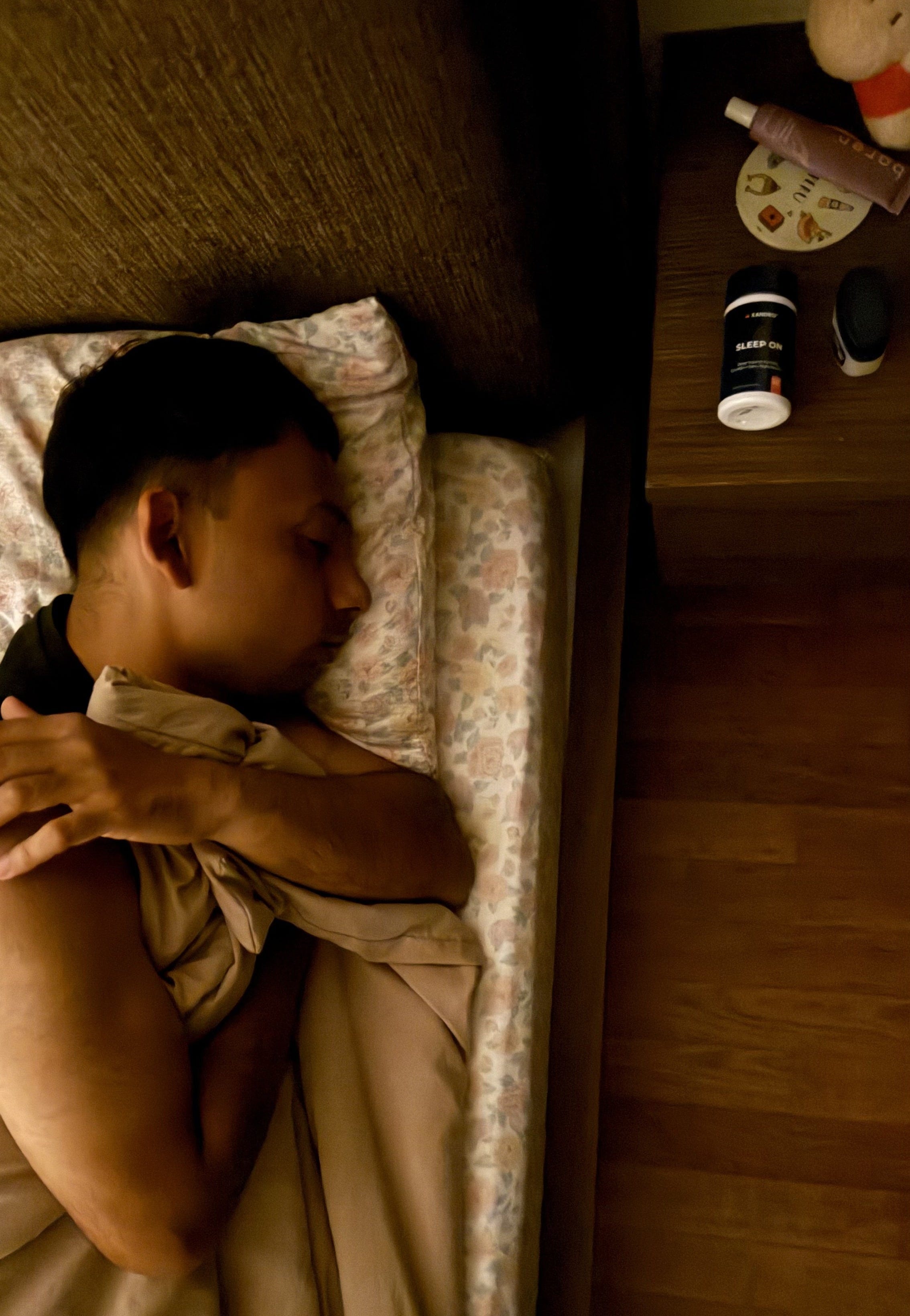
We also just launched Sleep On, our first sleep health product. So for this week, I want to share what I have actually learned about sleep.
In this post:
Why sleep is an compounding asset
Most people are treating the wrong problem
The sleep aid stack, mapped
How to actually choose
What no supplement fixes
1. Compounding asset
Every health input we make, training, nutrition, supplementation, stress management, gets processed overnight. Sleep is where memories get consolidated, muscles get repaired, stress hormones get reset, and creativity gets rebuilt for the next day. When sleep is bad, we start losing the benefits of everything else we are doing right.
The consequences stack up faster than most people expect. A systematic review and meta-analysis published in Sleep Medicine Reviews found that in otherwise healthy adults, even short-term sleep disruption is linked to increased stress reactivity, mood problems, and cognitive decline, and that chronic disruption raises the risk of hypertension by 54% and type 2 diabetes by 63% compared to normal sleep duration (Johnson et al., Sleep Medicine Reviews, 2021 — read the study). These are not outcomes from clinical insomnia. They are outcomes from ordinary, chronic bad sleep in people who considered themselves basically fine.
When sleep breaks down, the body does not switch off the way it should. Stress hormones stay elevated, recovery slows, and everything downstream suffers.
Research on athletes makes this tangible. A review in Current Sports Medicine Reports found that better sleep duration and quality is consistently associated with improved performance, faster recovery, and lower injury risk (Watson, Current Sports Medicine Reports, 2017 — read the study). The same logic applies off the track. If we are not sleeping well, we are not getting the full return on everything else we put in.
Sleep is the one lever that amplifies or discounts every other lever we pull.
2. Wrong problem
Most people treating their sleep are treating the wrong thing. They buy something, it does not work and then they try something else. The problem is they are skipping the diagnosis.
There are five types of sleep problem and they do not respond to the same things.
The first is an onset problem. You cannot fall asleep. Mind is running, you are lying there for forty minutes before anything happens. This is usually a circadian timing or anxiety-driven issue.
The second is a maintenance problem. You fall asleep fine but wake at two or three in the morning and cannot get back. Stress and worry keep the nervous system from settling. It is not the same as an onset problem and treating it like one does not help.
The third is a depth problem. You sleep through the night and get your hours, but wake feeling unrestored. HRV is flat, readiness is low. Deep sleep is not happening, and no amount of melatonin fixes that because melatonin signals timing, not depth.
The fourth is circadian disruption. Your body clock is shifted through late nights, screens, travel, or inconsistent schedules. Sleepy at the wrong times, alert when you should not be.
The fifth is age-related change. Research published in Sleep Medicine Clinics found that normal aging brings more frequent night wakings, reduced deep sleep, and a weaker body clock, independent of other health factors (Li et al., Sleep Medicine Clinics, 2017 — read the study). If you are over 40 and sleep has gradually shifted, this may be part of it.
Before choosing anything, know which category you are in. If you have a wearable, look at your sleep stage data. If not, track three things: how long it takes to fall asleep, whether you wake during the night, and how you feel ninety minutes after waking. That profile gives you a better direction than a “sleep score”.
Note: Some sleep problems are clinical. They need a doctor, a proper assessment, and sometimes medication. If you have done the basics consistently and nothing is improving, please see a sleep specialist. Singapore has some good sleep specialists, and a proper diagnosis can change everything. Supplements are a lifestyle tool. They are not a substitute for medical care when medical care is what you actually need.
3. The stack, mapped
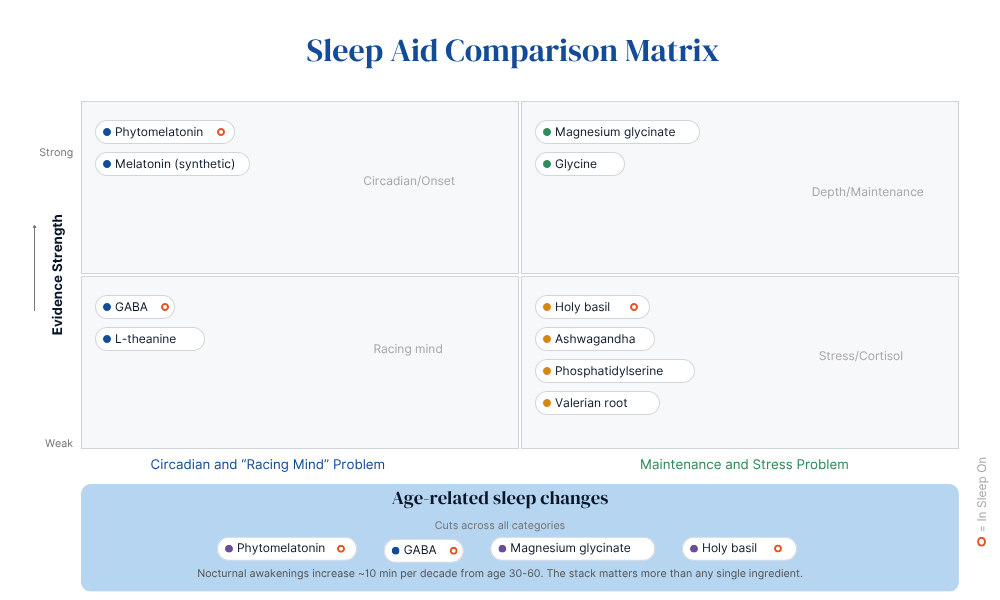
The visual below maps the main sleep aid ingredients on two axes. Left to right is your problem type and top to bottom is evidence strength from published human clinical data. Orange rings mark what is inside Sleep On.
A few things worth noting.
Melatonin, both synthetic and phytomelatonin, addresses sleep onset and circadian problems. Based on a 2024 systematic review published in the Journal of Pineal Research found that melatonin reduced sleep onset latency by 9.31 minutes and increased total sleep time by 19.67 minutes compared to placebo (DOI).
The same study found that efficacy peaks at 4mg per day, and that taking it three hours before the desired bedtime, rather than the typical thirty-minute window, produces significantly better results. The standard clinical advice of 2mg at thirty minutes before bed has an efficacy close to zero according to their model.
GABA sits in a different part of the matrix. It is the primary inhibitory neurotransmitter in the brain. When your nervous system is running too hot at bedtime, whether from a long day, screens, or unresolved stress, GABA is what helps bring it down. Based on a randomised placebo-controlled trial using exactly 200mg of GABA daily, the same dose in Sleep On, showed improved sleep efficiency and increased heart rate variability over 90 days (DOI).
Holy basil, the Holixer extract in Sleep On, addresses the third mechanism. Its role is to calm the mind and bring cortisol down. Cortisol is your stress hormone. When it stays elevated into the evening, it keeps you wired when you should be winding down. Holy basil is an adaptogen, meaning it helps the body manage stress more effectively over time. The evidence for holy basil on stress is stronger than its direct sleep data, which is why it works best as part of a full stack rather than on its own.
For people whose sleep problem is primarily stress and cortisol-driven, ashwagandha and phosphatidylserine are also worth understanding. Ashwagandha has several RCTs showing HPA axis regulation and cortisol reduction. Phosphatidylserine blunts the cortisol spike that tends to hit high-output individuals in the evening. Both sit in the moderate evidence tier and are most relevant if your problem is the maintenance or stress quadrant of the matrix, waking at 2am, inability to wind down, or sleep that feels light and unrestored despite getting the hours.
Magnesium glycinate does not sit inside Sleep On but remains one of the most broadly useful additions to a sleep stack. It supports GABA activity, muscle relaxation, and slow-wave sleep continuity. I take it every night.
Valerian root is popular but the trial evidence is mixed across preparations and populations.
4. How to choose
The logic is simple once you know your problem type.
Onset problem, go left on the matrix. ⬅️
Maintenance or stress-driven, go right. ➡️
Depth problem, start with magnesium glycinate and glycine.
Then look at evidence strength. Prefer compounds with multiple published human trials. Most supplement marketing does not make this distinction clearly. You have to look for it.
The important thing to understand about Sleep On is what it is not. It is not a sedative. It does not force you to sleep. If you are looking for something that knocks you out fast, that is not this product and it is probably not what you actually need.
Sleep On is built around three mechanisms working together. Phytomelatonin handles your circadian signal, telling your body when to sleep. GABA quiets the neurological noise that keeps you alert when you should be winding down. Holy basil addresses the upstream cortisol load that, left unmanaged, keeps the system in a wired state even when you are tired. Together they support the conditions your body needs to sleep well, consistently, over time.
Current sleep aids in the market target one mechanism. Sleep On supports the entire system. It is a different product philosophy and it is why the results build rather than plateau.
5. What it cannot fix
Supplements support a sleep system. They do not build one.
If you are on your phone until midnight, no stack corrects that. I know this because I am still working on it. If your room is warm and lit, melatonin is working against the environment. If you are drinking regularly, deep sleep architecture is impaired in ways that supplements do not reach. If you are running a chronic sleep deficit, you need more hours, not better compounds.
The foundations are boring - Consistent sleep and wake times. A dark, cool room. A wind-down period without screens. Alcohol reduced or removed. Exercise, but not within two to three hours of bed.
The gap between where my sleep is and where it could be is not a supplement gap. It is a discipline gap. So, build the system first. Then use the stack to optimise it.
Until next week,
Shan
Sleep isn't a luxury line item ...it's the infrastructure. Really like the diagram for solutions.