Non-Sleep Deep Rest: The Most Accessible Recovery Tool
Everyone knows sleep is important. Everyone also knows they don’t get enough of it. And yet, for most people, fixing sleep feels impossible. Is there a way? Let's find out.
Hi, I’m Shan. I run Xandro Lab, a longevity science brand in Singapore. Every Sunday, I sit down to write here on Out of Singapore. It started in March 2023 as a way to keep a journal, a place to share what I was building, what I was learning, and things I was struggling with. This week I will discuss a topic that’s been on my mind all week: sleep.
Not because I’m a sleep scientist. I’m not. I’m an operator, a builder in the longevity space. My work at Xandro Lab sits at the intersection of longevity, performance, and recovery. And the more I meet people — in workshops, at events, or just over coffee — the more I realize this: almost everyone knows their poor health is tied to bad sleep. But for most, sleep feels impossible to fix.
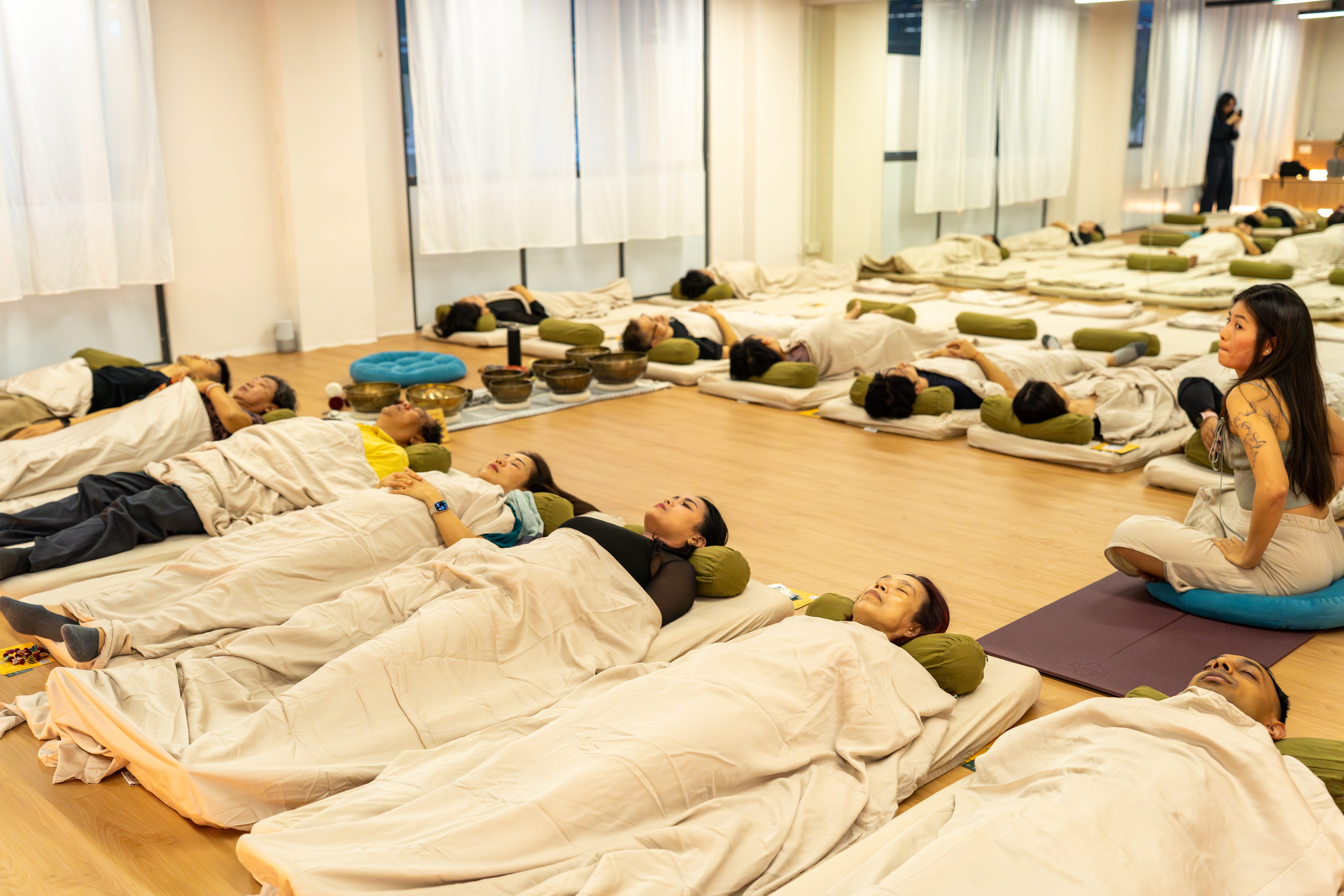
Last week we hosted a sleep science workshop with about twenty people. Kathy, a therapist, broke down common misconceptions about sleep, and then guided us through forty minutes of Yoga Nidra. Neuroscientists call it non-sleep deep rest, or NSDR. Lying flat on the floor with my eyes closed, drifting between wakefulness and sleep, I realized something simple: Sleep is the foundation. But when it breaks, recovery practices like NSDR are what keep us going.
Today’s reading includes -
Why sleep is both known & unfixable
The half-a-trillion-dollar sleep industry
The science of sleep cycles
The myths of sleep
Non-sleep deep rest (NSDR)
Sleep at work
Why I care as an operator
Closing reflections
Let’s start.
1. Why Sleep Is Both Known & Unfixable
Every conversation I’ve had about health — whether with friends, colleagues, or consumers at Xandro — eventually circles back to sleep. It’s the foundation. You don’t sleep well, your body breaks down. Metabolism slows, weight creeps up, mood dips, and focus disappears.
The strange part is not the knowing. It’s the resignation.
People I meet will admit their sleep is bad, and then shrug as if it’s permanent. “That’s just how it is with my job.” “I can’t switch my brain off.” “Kids wake me up all the time.” “I travel too much.” Some even say: “My sleep is unfixable.”
The reality is that poor sleep is rarely about ignorance. It’s about feeling trapped.
For some, it’s work. Long hours, unpredictable shifts, or late-night emails create patterns the body can’t easily unlearn.
For others, it’s stress or trauma. The body may be exhausted, but the nervous system stays wired from stress or trauma.
For many, it’s environment. Noise, light, a bed partner with different rhythms — small disruptions that accumulate into restless nights.
I’ve noticed another pattern: when people talk about health, they believe diet and exercise are things they can control, but sleep “just happens.” You can force yourself to eat differently or sign up for a gym. But you can’t force yourself to fall asleep.
Even when people try, the results are mixed. Some turn to pills or supplements. Some buy expensive mattresses or gadgets. Some meditate, some drink herbal teas. Sometimes it helps. Often it doesn’t. And so the cycle continues: people know sleep is destroying their health, but they learn to live tired.
What I realized after our workshop is that this gap — between knowing and fixing — is where recovery practices like non-sleep deep rest can play a role. They don’t fix sleep. Nothing does, instantly. But they give you a lever to pull on the days when sleep just won’t come.
2. The Half-a-Trillion-Dollar Sleep Economy
When something feels unfixable, it becomes a market. And sleep is now one of the biggest markets in health.
The “sleep economy” was estimated at over $585 billion in 2024, and it keeps growing. Within that, the global market for sleep aids alone was worth about $87 billion, projected to almost double to $162 billion by 2034. There are devices for apnea, trackers for REM cycles, smart mattresses that heat one side and cool the other, and even hotels that promise “sleep sanctuaries.”
At first glance, this looks like progress. People clearly care about sleep. They’re spending billions trying to fix it. But if you zoom out, it’s also a picture of desperation.
Because what the market is really selling is an attempt to control what we can’t.
Beds and Mattresses. Once a commodity, now a science project: cooling gel layers, memory foam, adjustable firmness, even “grounding” mattresses that claim to connect you to the earth’s frequency.
Sleep Aids. From melatonin gummies to magnesium glycinate and ashwagandha, supplements have become a nightly ritual. On the medical side, prescribed sleeping pills — often sedatives like zolpidem — are a multi-billion-dollar business of their own. They knock you out, but they don’t always give restorative sleep.
Sleep Tech. Smart watches, Oura rings, Whoop bands, and bedside devices that score your REM cycles. This category alone could reach $65 billion by 2033.
Sleep Apnea Devices. CPAP machines and airway devices for sleep apnea already represent a $13 billion market. This isn’t wellness; it’s survival.
Sleep Tourism. Yes, that’s real. Hotels and resorts market entire packages around sleep — blackout curtains, aromatherapy, custom mattresses, silent rooms. A niche, but growing.
Even silence and darkness are products now. Blackout curtains, triple-glazed windows, noise-absorbing panels, eye masks, white-noise machines.
I’ve felt this personally. I live next to a highway, and I’m a light sleeper. It isn’t the hum of traffic that wakes me — it’s the superbikes and sports cars that rip through at night, their exhausts jolting me awake.
I’ve tried solving it with gadgets. A Garmin watch to track my sleep cycles — but then I could feel the band pressing on my wrist all night, which became its own distraction. Instead of sleeping, I was more aware of not sleeping. I tried an eye mask, but it was the same. Just another accessory strapped to my body, making me more sensitive to every disturbance.
That’s the paradox of the sleep industry. The very tools meant to help you rest often become the reasons you don’t.
Note - What has helped me more is supplementation (along with good sleep hygiene). I take magnesium glycinate — partly to ease muscle pain after training, and partly to improve sleep. Most nights, it makes a difference.
3. The Science of Sleep Cycles
If there’s one thing the workshop reminded me, it’s that sleep is not a single state. It’s a cycle — a dance of stages that repeat four to six times every night, each lasting about 90 minutes. Within those cycles, your brain and body do very different kinds of work.
Here’s the breakdown:
Light Sleep (Stage N1 & N2): This is where most of your night is spent — almost 50% of total sleep. It’s the transition stage, where heart rate and breathing slow, muscles relax, and body temperature drops. It’s easy to wake up here, which is why a door slam or highway noise can pull me right out of it. Light sleep doesn’t feel restorative, but it’s the bridge into deeper stages.
Deep Sleep (Stage N3, also called Slow-Wave Sleep).
Usually about 20–25% of the night, and concentrated in the first half. This is the body’s repair window: tissue growth, muscle recovery, immune system strengthening. It’s also when memory consolidates — short-term experiences become long-term knowledge. If you wake up groggy and disoriented, you were probably pulled out of deep sleep.REM Sleep (Rapid Eye Movement).
About 20–25% of the night, concentrated in the second half. This is when the brain is most active. Dreams happen here. REM is closely tied to creativity and problem-solving — your brain connects dots it couldn’t when awake. It also supports emotional regulation. Miss REM, and you feel irritable, unfocused, less resilient.The Cycle.
A healthy adult moves through light → deep → REM in about 90 minutes, then repeats. Four to six times a night. If you track your sleep with a wearable, you’ll often see this rhythm. But as I found with my Garmin, wearing the device can be more distracting than helpful. The science is fascinating, but real sleep doesn’t always cooperate with perfect graphs.
How this changes with age.
When you’re 20, you can get away with five or six hours and still function. Deep and REM sleep come more easily. As you age, it shifts. Deep sleep shortens. REM becomes more fragmented. A 70-year-old may only get four hours of continuous sleep — not because they “need less,” but because their architecture has changed. They wake up more, spend longer in light sleep, and struggle to complete full cycles. That’s why older adults often feel unrested even after “enough” hours in bed.
How you measure it.
Consumer wearables (Garmin, Oura, Whoop, Apple Watch) use movement and heart rate to estimate cycles. They’re not perfect — lab-based polysomnography with EEG is the gold standard — but for most people, even a rough picture helps. You see the pattern of when you hit deep sleep, when you enter REM, and how consistent your cycles are.
Why this matters.
Each stage of sleep restores something different. Miss deep sleep, and your body feels broken. Miss REM, and your mind feels broken. Sleep isn’t just about “how many hours” — it’s about whether you’re completing the cycles that let your brain and body do their work.
4. The Myths of Sleep
For something we do every night, sleep is surrounded by myths. Some sound harmless, but when you look closer, they reveal why so many people keep struggling.
Myth 1: You can “catch up” on weekends
Many people burn through the week on five or six hours a night, then try to sleep 10–12 hours on Saturday and Sunday. The science shows it doesn’t work. Sleep debt can’t be fully repaid. Extra hours may reduce short-term fatigue, but they don’t restore the lost deep and REM cycles. Worse, “catch-up weekends” often reset circadian rhythms, making Monday mornings even harder.
Myth 2: The earlier you sleep, the healthier
There’s a cultural bias toward early sleepers being “disciplined” and late sleepers being “lazy.” But what matters more than the clock is consistency. Going to bed at 11 p.m. and waking up at 7 a.m. every day is healthier than sleeping at 9 p.m. some days and midnight on others. The brain and body thrive on predictable cycles.
Myth 3: Older adults need less sleep
It’s not that older adults need less. It’s that their sleep architecture changes. Deep and REM sleep become harder to sustain. They may spend longer in light sleep, wake up more often, and struggle to complete cycles. Many accept this as “normal aging,” but it’s more accurate to say their bodies can’t achieve the same restorative sleep, not that they require less.
Myth 4: Sleep problems in midlife are just “normal” aging
One of the most overlooked drivers of poor sleep is menopause. Hot flashes, night sweats, and hormonal shifts make it harder to fall and stay asleep. Estrogen and progesterone — two hormones that decline during menopause — both play important roles in regulating circadian rhythms and supporting deep sleep.
The result: women in perimenopause and menopause often report more frequent awakenings, lighter sleep, and reduced REM.
This matters because poor sleep during menopause doesn’t only impact rest. It has downstream effects on metabolic health, mood, memory, and cardiovascular risk. Treating it seriously — whether through medical support, lifestyle changes, or recovery practices — is critical.
Myth 5: Supplements can replace sleep hygiene
Magnesium, ashwagandha, melatonin, valerian extract, and countless “sleep stacks” are everywhere. Some help — I take magnesium glycinate myself, especially after heavy training days. But no pill can replace the basics: a consistent routine, the right environment, and respect for the body’s natural rhythms. Supplements can be a tool, not a solution.
Myth 6: Colder sleep is always better
This one is nuanced. Science shows that the body’s core temperature naturally drops at night — by about 1°C — and that a cooler environment helps trigger this process. That’s why most sleep researchers recommend bedroom temperatures between 18–22°C (64–72°F). Cooling the body signals the brain that it’s time to rest.
But here’s where lived experience matters. I’ve tried it myself: hot shower, then sleeping at 22–24°C. I found it too cold. I felt too cold, woke up more, and didn’t sleep deeply. I now keep my room closer to 27°C. Meanwhile, I have friends who swear by 17°C, and others who sleep comfortably at 28°C.
The truth is that relative comfort matters more than hitting a universal “ideal.” If you’re too cold, your body keeps micro-waking to generate heat. If you’re too warm, you toss, turn, and sweat. Science gives us ranges, but sleep is personal. The real test is whether you can stay asleep through the night.
5. Non-Sleep Deep Rest (NSDR)
When Kathy guided us through forty minutes of Yoga Nidra at the workshop, it felt unusual at first. Twenty adults lying on mats in silence, eyes closed, drifting between wakefulness and sleep. But by the end, people got up calmer, lighter, almost as if they’d taken a short holiday for the nervous system.
That’s what scientists now call Non-Sleep Deep Rest (NSDR).
What it is
NSDR is a state where the body is deeply relaxed, but the mind remains lightly aware. It’s not meditation — which often requires focus — and it’s not sleep, where awareness fades completely. Instead, it’s a structured practice of lying still, slowing the breath, and following a guided body scan or visualization. Yoga Nidra is the most common form.
How it works scientifically
During NSDR, brain waves shift toward the same slow frequencies seen in early sleep stages (theta and delta waves). The parasympathetic nervous system — the “rest and digest” mode — becomes dominant. Cortisol, the stress hormone, drops. Heart rate and breathing slow. In this state:
Stress resets. A 10–30 minute NSDR session has been shown to reduce cortisol and sympathetic arousal.
Learning consolidates. Huberman Lab and other neuroscientists point to studies showing NSDR improves memory retention — the brain takes in new information better after rest.
Energy recovers. Many people describe NSDR as “a power nap without the grogginess,” because you avoid sleep inertia (the heavy, disoriented feeling after waking from deep sleep).
Emotional balance. Like meditation, NSDR can reduce anxiety and help regulate mood, but it’s often easier to access since it requires no special skill beyond lying down and listening.
How to do it
The simplest way:
Lie down in a quiet space.
Close your eyes, place arms by your side, palms facing up.
Use a guided NSDR audio (many are free online — even Huberman has posted one).
Follow the voice as it takes you through breath awareness, then scanning different parts of the body, slowly relaxing each one.
If you fall asleep, that’s fine. If you don’t, that’s fine too. The point isn’t “performance,” it’s rest.
Even 10 minutes can reset your system. Twenty to forty minutes brings deeper benefits.
Why it matters
For me, the biggest value of NSDR is accessibility. Unlike sleep itself — which is hard to control — NSDR is something you can choose to do during the day. It doesn’t replace sleep, but it gives you a lever to pull when you’re too stressed, too wired, or too tired to function.
When sleep feels unfixable, practices like NSDR remind us that recovery doesn’t always require eight perfect hours at night. Sometimes it just requires lying down, closing your eyes, and letting the body do what it knows best: rest.
6. Sleep at Work
Here’s a thought: what if the next big HR policy wasn’t free snacks or flexible Fridays — but nap time? Or better yet, twenty minutes of guided NSDR after lunch.
It sounds strange, but so did meditation in offices a decade ago. Today, mindfulness programs are mainstream. Companies know that better focus, less stress, and sharper decision-making directly affect performance.
Sleep and recovery are no different. A short NSDR break is cheaper than another coffee machine, and the returns — more alert employees, fewer mistakes, calmer teams — are hard to ignore.
Maybe the future workplace isn’t just about productivity hacks. Maybe it’s about building recovery into the culture. (I can already imagine offices with Sauna, cold plunges, meditation rooms and strength training equipments - this is something I working towards for Xandro’s new office).
7. Why I Care as an Operator
I write about this not as a sleep scientist, but as someone building the longevity ecosystem. When I think about all the levers people can pull for better health — nutrition, exercise, recovery, mindset — sleep stands out as the most powerful, and the most neglected.
At Xandro, most of the people I meet already know their sleep is broken. They talk about supplements, workouts, diets, but when it comes to sleep they shrug: “It’s unfixable.” That resignation is dangerous, because poor sleep doesn’t just make you tired — it compounds into worse metabolic health, higher stress, memory loss, and faster aging.
That’s why I care.
It’s also why I’m curious about building solutions here. We’ve started sketching ideas for something we half-jokingly call Protocol Z — our way of exploring sleep as part of the broader longevity toolkit. We’re early, still learning, but it’s clear the demand is there.
The sleep economy is booming. Athletic Greens has experimented with AGZ. Every major wellness brand now has a “sleep formula.” Hotels are designing “sleep rooms.” And yet, I can’t shake the feeling that most of these solutions are chasing symptoms, not addressing the core.
For me, it’s less about adding another product to the stack, and more about asking: How do we help people recover better? How do we make sleep less of an unfixable problem and more of a skill that can be supported?
That’s the question I’ll keep exploring.
8. Closing Reflections
We still don’t fully understand sleep. Scientists debate why we spend a third of our lives in it, why some people can function on five hours while others collapse without eight, why it breaks down with age, and why it refuses to be “hacked.”
What I do know is this: sleep may not be instantly fixable, but recovery is.
That was my biggest takeaway from the workshop. Lying flat on a mat for forty minutes, practicing NSDR, I felt what so many people around me felt too — calmer, lighter, more present. It didn’t solve everything. It didn’t make the superbikes on the highway quieter or my stress disappear. But it reminded me that there are tools we can reach for when sleep doesn’t cooperate.
The sleep industry will keep growing. There will be more pills, smarter mattresses, darker curtains, quieter rooms. Some of them will help. Others will only distract. But maybe the real opportunity — for individuals, companies, and even us at Xandro — is to build practices and products that make recovery more accessible.
So here’s my question for you: What’s your biggest struggle with sleep — and have you found anything that truly helps?
Because this is one area where I believe community can matter as much as science.
That’s all for this week. Next Sunday, I’ll be back with another note from the journey of building in longevity and performance.
If you enjoyed this post, please give it a like, or share it with a friend who might be struggling with sleep — it helps more than you think.
See you next week.
—Shan


