


👋 I’m Shan. I co-founded XANDRO, a longevity science company in Singapore. Every week I write these notes — part building diary, part thinking out loud. This week is a follow-up to last week’s BioCap post, and it gets into the harder question.
How do you actually measure it? Let’s get into it.
Today, we will talk about:
The wrong question
The age problem
Capability wins
The framework
Where this is going
1. The Wrong Question
The entire longevity industry has built itself around a single obsession: making you feel younger than your passport says. Or “reverse-aging” as they say.
The implicit promise is always the same. Submit your blood, your saliva, your cells. We will tell you how young you really are.
Epigenetic age. Biological age. Organ age. Metabolic age. Heart age. Brain age. Each company has their own clock and methodology. Each produces a number that compares your biology to what is typical in someone younger. The goal is always to be younger.
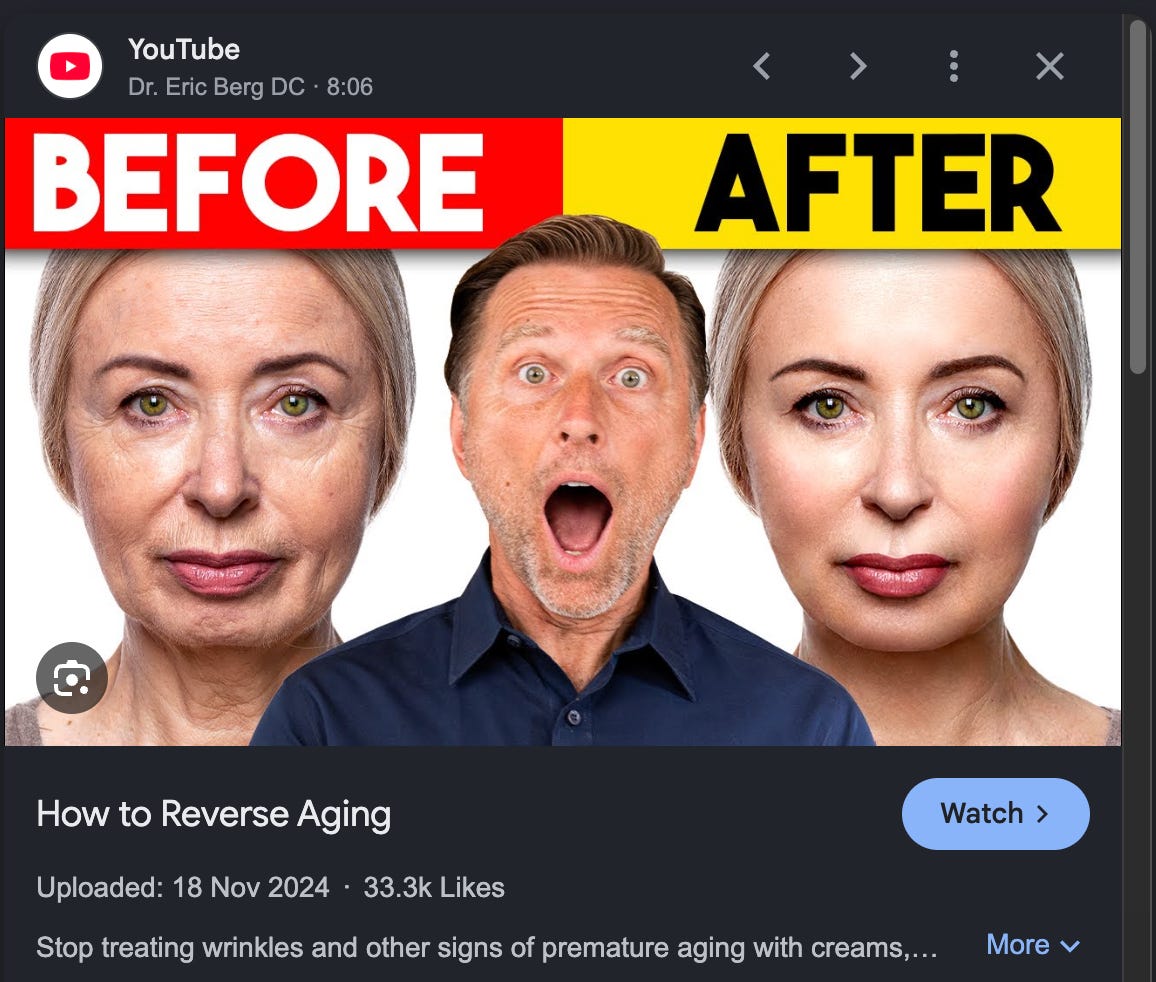
I think this is wrong framing and approach. The question “how old are you biologically” leads somewhere uncomfortable. It implies the goal of longevity work is age reversal. And age reversal is a contested concept that most serious scientists disagree on, most consumers are skeptical of, and most regulators will not allow you to claim. You are building a measurement system on a foundation that is neither scientifically settled nor socially accepted.
There is a better question. I will get to it.
2. The Age Problem
Bryan Johnson spends approximately USD 2 million a year on his biology. He has a team of doctors, daily blood draws, continuous monitoring, and a protocol that most people could not follow even if they wanted to. He publishes his results publicly and in detail. He is the “most optimised human” on the planet (self-claimed).
And his most quoted line is some version of: my body is performing like a much younger person’s - heart, skin, libido and so on.

Here is what I think: so what?
Not because I doubt the measurements. But because knowing that Bryan Johnson’s cardiovascular system benchmarks like a 25-year-old tells me nothing about what Bryan Johnson can do. It tells me something about his cells. It tells me nothing about his output, his capability, or his recovery. It is interesting as a data point. It is not a useful goal.
And when you say it to a normal person — they find it slightly absurd. “You’re biologically 15 years younger than you are.” The claim is too abstract to land. You cannot feel younger. You can feel stronger. You can feel sharper. You can feel like you recovered faster than you expected. Those things land because they are about capability, not age.
Bryan Johnson is not the only one. There is a whole ecosystem of longevity “activists,” as I would call them, whose communication is built around this frame. Some of them are doing genuinely important science. But the measurement story they tell the public is still stuck in age. Younger. Reversal. The language of undoing rather than building.
I think it is the wrong language and the wrong goal. And I think it is holding the field back from a more honest and more useful conversation.
3. Capability Wins
Here is what I actually care about when I think about my own biology and the biology of the people we are building for.
Can you lift 1x your bodyweight at 70?
Can you run 30K a week at 65?
When you push your body hard, how fast does it recover? Are you back in twenty-four hours or are you back in four days? That gap is enormous, and it tells you more about your biological capital than almost any blood marker.

Can you stay sharp for a twelve-hour day? Not occasionally. Consistently. Can you process information, make decisions, stay present when the stakes are high, and do it again the next day?
These are capability questions. They are output questions. They do not ask how old you are. They ask what you can do.
A seventy-year-old who can lift twice their bodyweight and run thirty kilometers a week is not just “biologically younger than their age.” They are a high-performing seventy-year-old. That is a different and better claim. It is concrete. It is something other people can see and verify. It is something the person themselves can feel every single day, not just when they get a test result back.

This is what biological capital actually looks like when it is accumulated. A demonstration of what your body can produce.
Recovery deserves its own paragraph because it is underrated as a metric. Anyone can push hard once. What separates high biological capital from low biological capital, especially as you age, is the speed and quality of recovery. How quickly does your heart rate variability return to baseline? How many nights of sleep does it take before you feel normal again? How quickly does your strength return after a hard training block?
4. The Framework
We have been working on the measurement framework for Biocap. I want to be clear that this is early-stage and ongoing. But the direction is clear enough that I want to share it.
The early framework is built on six asset classes.
Cardiovascular output. VO2 max is the anchor here because it is the single most powerful predictor of all-cause mortality in the literature. Research following more than 6,000 men found that each meaningful step up in cardiorespiratory fitness was associated with a 13% improvement in survival, independent of age, smoking status, and cardiovascular risk factors (Myers et al., New England Journal of Medicine, 2002). Beyond VO2 max, gait speed — how fast you walk — turns out to be one of the most reliable predictors of functional independence and survival in older adults, with a pooled analysis of 34,485 people across nine cohorts showing it predicts survival better than most clinical measures (Studenski et al., JAMA, 2011).
Trivia: MET
MET stands for Metabolic Equivalent of Task. It is a unit measuring how hard your body is working relative to sitting still. Sitting at rest = 1 MET. A brisk walk = 3-4 METs. Running = 8-10 METs. Your VO2 max (the maximum oxygen your body can use at peak effort) is expressed in METs — one MET equals roughly 3.5 mL of oxygen per kg of bodyweight per minute. So "one MET improvement" means a meaningful step up in your peak exercise capacity.
Musculoskeletal health. Not body weight. Not BMI. Grip strength, skeletal muscle mass, and the functional question of what you can actually lift and carry. Sarcopenia — the age-related loss of muscle mass — is a clinical condition that predicts mortality, hospitalisation, and loss of independence (Cruz-Jentoft et al., Age and Ageing, 2019). Grip strength alone predicts survival: a large study across 17 countries and 142,861 people found that each 5 kg decrease in grip strength was associated with a 16% higher all-cause mortality risk, independent of other factors (Leong et al., The Lancet, 2015). These metrics have population-level data, validated cutoffs, and direct relevance to what you can do every day.
Metabolic health. HbA1c, fasting insulin, the triglyceride-to-HDL ratio, inflammatory markers. The metabolic system is the engine underneath everything else. When it breaks down, every other asset class is compromised. When it is well managed, everything else performs better.
Sleep. Duration, consistency, efficiency, architecture. Sleep is probably the highest-leverage single intervention available to most people, and it is one of the most trackable. The consistency metric — how variable your sleep timing is from night to night — is underused and highly predictive.
Cognitive function. Processing speed, working memory, sustained attention, executive function. The operational question of how sharply your brain performs under real-world conditions, and whether that is improving or declining. I believe this will gain more traction in the coming decade.
Cellular health. This is the deepest layer and the hardest to measure affordably right now. Biological age from epigenetic testing, NAD+ levels, inflammatory markers. Costs are falling and tools are improving. This is where the “younger than your age” data sits — and it does have value, just not as the primary metric.
Each of these asset classes produces a score. The goal is to build consistently over time, across all six, so that the total number compounds. That compounding number will be your Biocap.
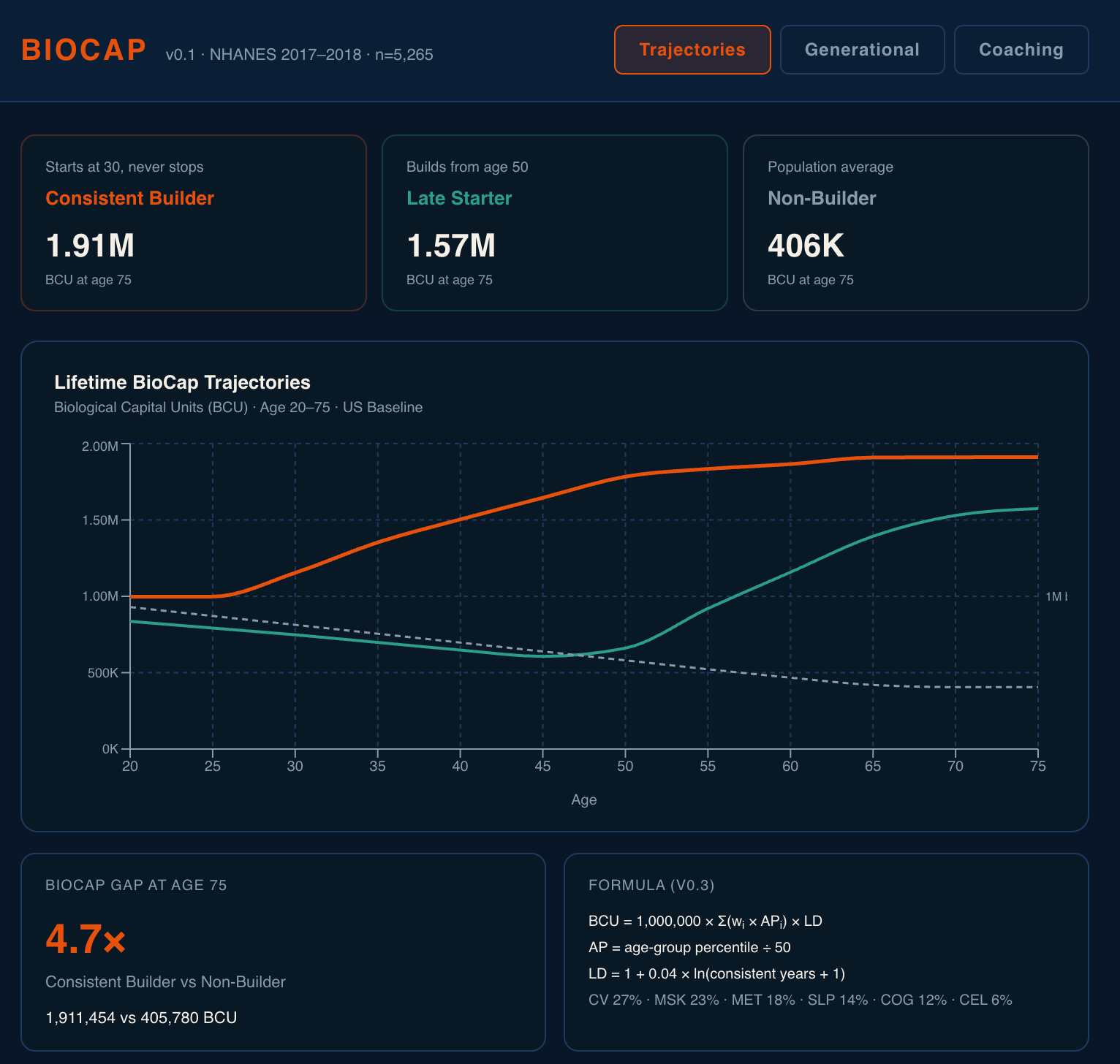
The other element that makes this different from a snapshot health score is the consistency dimension. Ten years of strong sleep earns more than ten weeks of strong sleep. Twenty years of cardiovascular training earns a multiplier that someone who just started cannot yet access. This is the biological equivalent of compound interest. Time in the asset matters, not just performance at a single point.
5. Where This Is Going
Let’s talk about what is solved and what is not.

The framework exists. The asset classes are defined. The weighting methodology is grounded in mortality prediction literature and functional independence data. We have built a pilot model on NHANES data — the US national health survey — that produces the three lifetime trajectories we expect: consistent builders compound upward, late starters turn it around, non-builders draw down.
What is not solved is the population-level reference data at scale, the measurement methodology for each asset class in a real-world consumer context rather than a clinical one, and the validation work that turns a framework into a peer-reviewed scientific instrument. That work will take time, the right scientific partners, and a serious data infrastructure. We are building toward all three.
The goal is a Biocap number that is as real and as trackable as a credit score. Something you can check, something that moves in response to real inputs, something that tells you whether you are building or drawing down, and something that holds up to scientific scrutiny. Not a marketing number. A scientific one.
This is a long endeavor. I say that not to hedge but because I think it is worth being precise about what kind of work it is. Redefining how a field measures itself can take years. It requires data, partnerships, and the willingness to be wrong about things along the way and correct them publicly.
What I am confident about is the direction. Capability over age comparison. Output over organ benchmarking. Compounding biological assets over snapshot biological clocks.
A seventy-year-old who is stronger, sharper, and recovering faster than they were at sixty is not reversing aging. They are doing something more interesting and more achievable. They are building.
That’s it for today. See you next Sunday.
Cheers,
Shan
If this landed for you, share it with someone who is thinking about this stuff. A founder, a parent, a friend in their forties who is starting to ask these questions. That is who this is written for.
I write here every Sunday. No polished press releases. An honest account of what it looks like to build a company in one of the most contested and most important spaces in health. The questions I cannot answer yet. The things I am figuring out in real time. This is one of them.
Come build with us.