From Ingredients to Protocols: Why Longevity Needs More Than NMN and Resveratrol
NMN and resveratrol got people excited about longevity — but they won’t take us far. The real breakthroughs will come from full protocols that combine science, behaviour and systems-level thinking.
👋🏼 Hi, I’m Shantanu — I run Xandro Lab, a science-first longevity brand in Singapore. I’ve spent the past two years building in the longevity and performance space.
Over the last few months, I’ve been watching how quickly this field is evolving. We’ve moved from “maybe try NMN” to hyperbaric oxygen therapy, red light devices in bedrooms, cold plunge studios, diagnostic panels and even full-scale longevity retreats.
And it isn’t just a trend. It’s happening at the exact same time as the world is ageing faster than ever before. By 2030, one in four people in Singapore will be over 65. In the US it’ll be one in five. Japan already crossed 29%. So the interest in longevity isn’t hype — it’s a very rational response to a very real problem.
That also explains why we suddenly see so many ingredients being discussed. Creatine for muscles. Taurine for brain function. Glycine for sleep. Magnesium malate vs bisglycinate vs citrate. NR vs NMN vs NADH. Every month, a new molecule is positioned as the missing piece.
Here’s the uncomfortable truth: none of these ingredients — on their own — will move the needle. They can help, yes. But longevity is a systems-level problem. Unless sleep, metabolic health, circadian rhythms, movement and stress regulation are all addressed together, you’re basically fixing one pathway while ten others drift out of balance.
That’s why I believe the next frontier is going to be blends — not single ingredients. Blends that are designed as part of a larger protocol and that evolve as science (and user data) progresses.
📌 Today’s Reading
Why single ingredients won’t be enough
The rise of longevity blends — the challenges nobody talks about
How we built Protocol X — and why we’re confident in protocols, not products
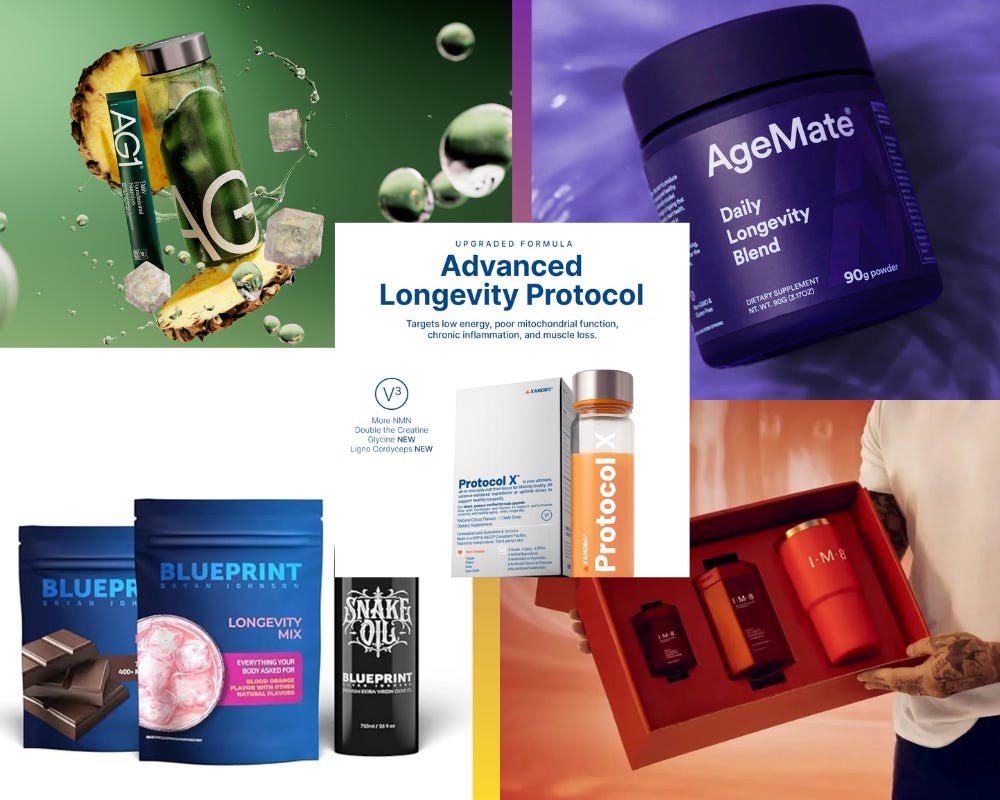
A Neutral comparison: Protocol X vs AG1, IM8, AgeMate, Novos, Blueprint
The future — where this whole space is headed next
1. Why Single Ingredients Aren’t Enough Anymore
Single compounds like NMN, resveratrol, taurine, creatine or spermidine are useful — but they’re ultimately limited by design. Each one targets a specific pathway or biological mechanism. NMN increases NAD⁺. Resveratrol is known for its effect on sirtuins and inflammatory pathways. Taurine has shown benefits in metabolic and cardiovascular health. Creatine supports muscular and cellular energy metabolism. Spermidine influences autophagy. But real longevity isn’t determined by a single pathway. It’s determined by how multiple systems work together — metabolic health, hormonal regulation, circadian rhythm, inflammation, stress response, musculoskeletal health, brain function, and so on.
And the problem with chasing one ingredient at a time is that you end up with a fragmented protocol. One supplement for recovery. One for inflammation. One for mitochondrial energy. One for cognitive function. At some point, you’re not improving longevity — you’re managing a spreadsheet.
This is where most people fail (and I include myself in that). It’s not that the science behind these ingredients is wrong — it’s that the system becomes too fragmented, too time-consuming and too difficult to execute consistently. Long-term adherence drops not because people don’t care, but because the protocol itself isn’t designed for real life.
That’s why the question eventually becomes: How do we maintain the scientific depth of a multi-pathway approach, without drowning the consumer in complexity?
And that’s where blends start to make sense.
2. The Rise of Longevity Blends — and the Challenges Nobody Talks About
As the limitations of single ingredients became obvious, the market naturally moved toward blends — formulas that combine multiple evidence-based compounds into one product. The idea is simple and powerful: instead of asking people to manage ten different supplements, give them a single, integrated formula that supports multiple longevity pathways in one go.
Blends also make behavioural sense. One sachet in the morning is easier to stick with than six different bottles and a spreadsheet. When something becomes a ritual, adherence goes up — and adherence is what drives results over time.
But there’s a problem most people don’t talk about.
Blends solve the complexity problem — but introduce new scientific challenges
When you combine multiple compounds into one formula, three things happen:
1. Dosing trade-offs: You may not get the full clinically tested dose of every ingredient. To keep the serving size and cost manageable, brands often reduce the dose of one ingredient so that another one can fit.
2. Interactions and bioavailability: Just because two ingredients work in isolation doesn’t mean they work well together. Certain polyphenols, minerals or amino acids can compete for the same transporters, affect absorption, or even reduce each other’s stability. In other words, A + B doesn’t always equal A +B — sometimes it equals 0.7A + 0.4B.
3. Very little actual evidence on the blend itself: Most brands (including us) rely on research from single-ingredient studies and assume it will translate to a compound formula. The truth is: few blends are tested in humans or animals as blends.
And the reason is simple — nobody has the incentive. Single-ingredient studies are usually funded by ingredient manufacturers or ingredient developers with a direct stake. Blends are consumer brand driven. Unless the brand itself chooses to run a study, those trials will never happen.
So yes — blends simplify the execution and open up the possibility of multi-pathway interventions. But they also require real formulation science, ongoing iteration, and actual validation to be meaningful.
3. How Protocol X Was Built — and Why We’re Confident in Blends
When we first started building Protocol X, we didn’t begin with “let’s make a blend.” The starting point was a much simpler question: What are the most important biological pathways we need to support if we want people to stay sharp, strong and functional as they age? Once we mapped that, the next challenge was: How do we deliver this in a way people can actually follow for decades?
That’s what led us to a blend — but we built it as a protocol, not a “product”.
Internal formulation + external review
Our internal product team developed the initial formula based on translational science across mitochondrial function, metabolic health, inflammation and neuronal resilience. Then we brought in 4 external experts — longevity researchers, medical doctors, exercise physiologists — to stress-test and refine it. Only after that review did we move into pilot production.
From science to real-world
Once we had a scientifically grounded formula, we tested it in the real world — taste, palatability, ease of use, format. That’s where the first learning happened. Some of the liposomal ingredients didn’t survive the sachet environment and started clumping. We pulled them, reformulated, and improved the stability.
Iteration by design
Protocol X was never meant to stay static. We built it to evolve. In the past 12 months, we’ve already moved into our third version, learning from both emerging science and real-world consumer feedback. Where most brands ship a blend and leave it unchanged for years, we treat it like a living protocol — improve what works, remove what doesn’t, upgrade as the research evolves.
We’re now entering the next phase: human biomarker studies, not to prove that each individual ingredient works, but to validate the blend as a system.
This is why we remain confident in the blend approach. Protocol X is designed to target multiple longevity pathways, is grounded in scientific research, and — just as importantly — is built in a form that people can actually stay compliant with over the long term.
4. AG1 vs IM8 vs AgeMate vs NOVOS Core vs Protocol X (Neutral Overview)
A number of serious blends have entered the longevity space over the past few years. Each has its own philosophy, design intent and evolution path. Here’s a neutral overview of where some of the key players sit today:
AG1 (Athletic Greens)
AG1 is excellent for broad nutritional coverage — vitamins, minerals, probiotics and phytonutrients — all in one daily serving. It’s ideal for people who want to establish a strong general wellness foundation and may not be ready (or willing) to go deep into longevity-specific pathways. The formulation has been improved over time and is supported by data on nutrient absorption and gut biomarkers.
IM8
IM8 leans more into the longevity and cellular health space. It combines NAD⁺-supporting compounds (via the NAD3® complex), algae-based DHA and a rejuvenation blend that includes resveratrol, urolithin A, berberine, astaxanthin and spermidine. It’s well-suited for people who already have their basic nutrition in place and want to target more specific ageing pathways. That said, there’s no publicly available data (yet) on how the full blend performs in humans.
AgeMate
AgeMate is designed around NAD⁺ restoration and methylation support, using ingredients like NMN, TMG, spermidine and quercetin. It’s a good option for people who want to focus on energy metabolism and cellular repair — especially those who prefer capsule formats over powders. The scientific references are mainly single-ingredient based and, similar to most blends in this category, there’s no published data on the full formula (yet).
Novos Core
Novos approaches longevity from a broader cellular and structural ageing perspective. It combines metabolic substrates (AKG, glycine, malate), joint and mitochondrial support compounds (glucosamine, hyaluronic acid, Rhodiola, L-Theanine) and longevity polyphenols (fisetin, pterostilbene). This blend tends to resonate with people who want a “whole-cell health” approach rather than focusing on a single pathway. The company has run a small internal biomarker pilot (not peer-reviewed) and the formulation has remained relatively stable.
Blueprint (Bryan Johnson)
Blueprint is less of a product and more of a full-stack personal protocol. It combines supplements with highly structured dietary, sleep and recovery routines based on continuous biomarker tracking. It’s an exceptionally data-driven approach, best suited for people who are willing to follow a strict, high-discipline programme. It’s not currently designed for large-scale commercial use — but it sets an interesting benchmark for how protocols can evolve.
Protocol X (Xandro Lab)
Protocol X sits somewhere in the middle — grounded in scientific literature, designed to address multiple longevity pathways (metabolic, inflammatory, mitochondrial, neuronal), but delivered in a habit-friendly format so people can actually stay compliant over the long term. It’s intentionally evolutionary (currently on Version 3 in the first year) and is preparing for human biomarker validation of the blend (planned for late 2025 / early 2026). It’s best suited for people who want more than a “general health” product, but aren’t ready for full Blueprint-level complexity.
5. The Future — Towards Full Longevity Protocols
Blends are a step in the right direction. They simplify complex routines and allow us to stack multiple pathways into one intervention. But they’re not the end state — they’re a bridge.
If society is ageing this fast — and if ageing is fundamentally a systems problem — then the long-term future lies in full protocols, not single products. That means combining:
Nutrition (including supplements)
Biomarker-driven diagnostics
Sleep and stress regulation
Movement and recovery frameworks
Periodic interventions (heat, cold, red light, HBOT, breathwork)
Software / data layers that make the above personalised and sustainable
Right now the entire ecosystem is fragmented. One company does supplements. Somebody else does diagnostics. Someone else builds devices. All of the friction sits on the consumer.
Over the next few years, I believe we’ll move from “products” → “protocols” → “ecosystems.”
And as consumers, we’ll shift from “what supplement should I take?” to “what protocol do I follow for the next 90 days?”
At Xandro, that’s the direction we’re moving towards — even if we don’t have all the answers yet. Some parts (supplement formulations) we control. Others (like wearables, biomarker platforms, guidance software) we’re actively exploring — through partnerships in Singapore and, increasingly, in other regions as well.
Ultimately the goal is not just to sell products, but to stitch together the different pieces of a real, usable longevity system. It’s messy. It pulls us in many directions. And we’re still figuring it out — but longevity is a hundred-year problem. The important thing is to keep building towards it, one piece at a time, and stay close to users so we know what actually makes a difference.
That’s the journey we’re on — and I’ll keep sharing the progress openly, as we figure it out in real time.
Closing Notes
Thank you for reading. If this piece gave you a different way to think about longevity protocols — or raised more questions than answers — I’d genuinely love to hear what’s on your mind.
Do you believe supplement blends can eventually evolve into full protocols?
👋🏼 Until next Sunday
— Shan


