


Hi, I’m Shan. I run Xandro Lab, a longevity science brand in Singapore. Every Sunday I write these notes, part building diary, part thinking out loud. This week I’m writing as a business operator. It’s how I think when I’m working through a problem.
I want Xandro to reach S$50 million, and to understand what that takes in practice. So I spent the week looking at Bloom’s energy drink, which has had one of the fastest climbs I’ve seen since Nutrabolt came in. Nutrabolt is an amazing story in itself, and I’ll write about it another time. Today it’s Bloom: how it got where it is, and what it would take for us to reach S$50 million.
Today’s read
Why I’m looking at this
The first US$175 million
Nutrabolt, Keurig Dr Pepper and the energy drink
What I take from Bloom
Singapore is not the US
What S$50 million looks like
What I’m testing
1. Why I’m looking at this
A lot is being bought and sold in health and wellness right now. In 2023, L Catterton took Thorne private in a deal worth about US$680 million. Thorne makes supplements and at-home health tests, and listed on Nasdaq in 2021. In April this year, Unilever agreed to buy Grüns, a greens gummy brand that only started in 2023. Axios reported the price at about US$1.2 billion, though Unilever never disclosed it, and the deal closed on 1 June. In India, Hindustan Unilever, which is Unilever’s Indian arm, bought 51% of OZiva and 19.8% of Wellbeing Nutrition at the end of 2022. That was its way into nutrition and wellbeing.
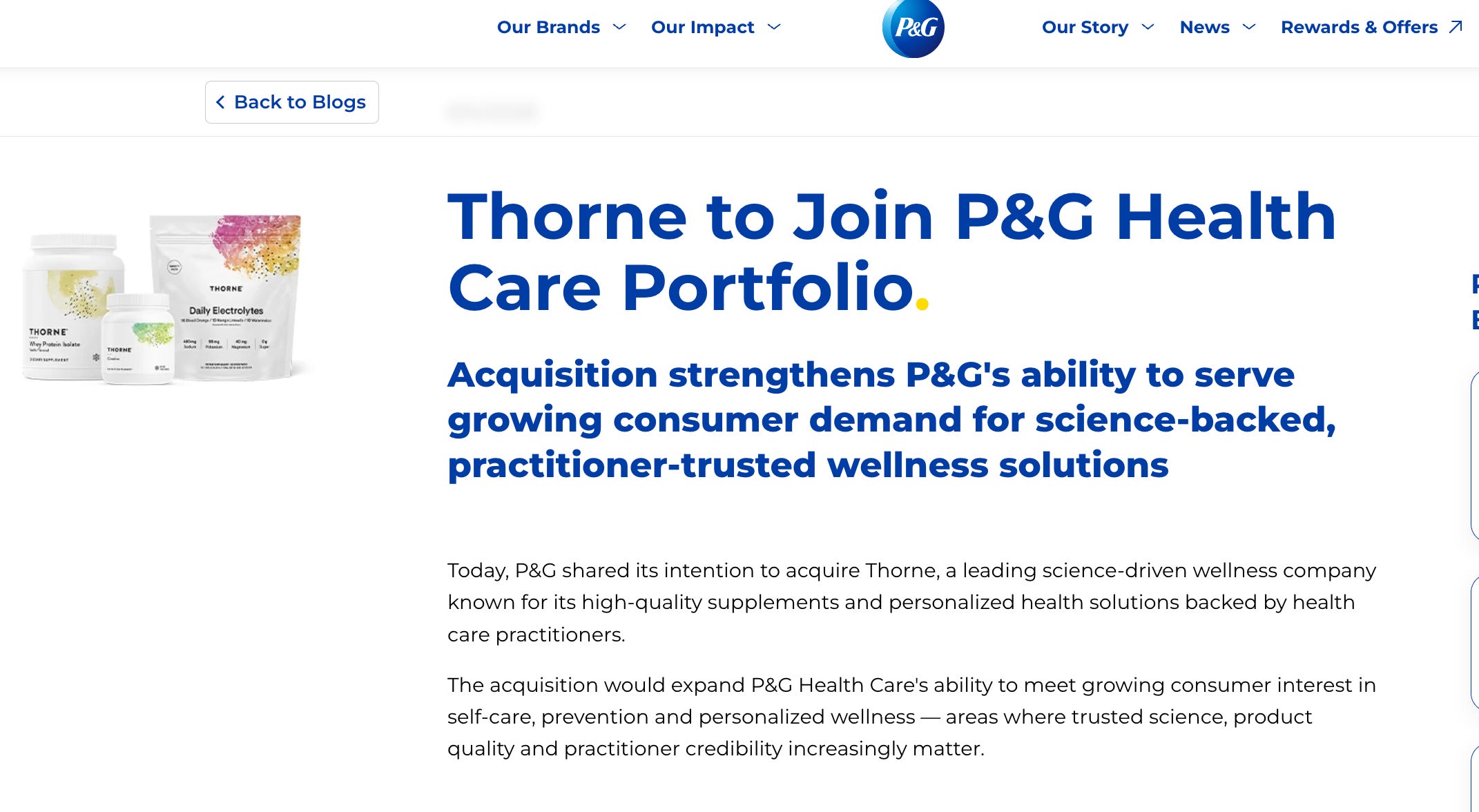
Part of this is US & India news, and it doesn’t map neatly to Singapore or Asia. I’ll come back to that. But I think it tells us two things. People with a lot of capital are paying attention to this space. And some brands have shown real skill, enough that big companies would rather buy than build.
I’m new in this space, still building, and I want to take Xandro to at least S$50 million. So the question I keep asking day to day is how. Some of it is basic. Product, distribution, marketing, and a strong team. Some of it is bigger and more strategic. Who should we work with, where should we manufacture, and what exactly should we sell.
That last one is not a passing remark. Product is the core of all this. Product first, then distribution. If a product can’t be bought again and again at a price people accept, nothing else holds up.
Bloom is useful for me because its path is easy to pull apart. An audience came first. Then early retail. Then a strategic partner with operating experience. Then drinks. Then national distribution. Each stage made the next one less of a guess. That’s what I want to look at.
2. The first US$175 million
Bloom was started in 2019 by Mari Llewellyn and her husband Greg LaVecchia. It began with a Greens & Superfoods powder. According to Inc., the two bootstrapped the business to around US$175 million in annual revenue before taking their first outside investment in January 2024.
It’s easy to read that as audience first, distribution later. A founder with followers, products that look good on camera, creators, a sharp sense of who the customer is. Bloom has all of that. But I don’t think that’s the full picture.
From what I understand, Bloom was selling direct, on Amazon and through big retailers before any large partner came in. What I take from it is simple. Distribution took them to the first US$175 million.
Think of each channel as another door. Selling direct is one door, and everyone has to come through your website. Amazon is another door, where people already shop. A big retailer is another, where people shop without looking for you. Each door lets a different kind of customer in. Bloom’s demand and its availability grew together, and each helped the other.
One more thing to hold on to. By the time any large partner came near Bloom, it already had customers and proof that people would buy. That matters in the next section.
I also read the founders as a good pair. Mari seems strongest with the consumer and the community. Greg looks like an exceptional operator.
3. Nutrabolt, Keurig Dr Pepper and the energy drink
Nutrabolt is the company behind C4, Cellucor and XTEND. It knows sports nutrition, pre-workout and energy drinks. Talks with Bloom began in early 2023. On the Taste Radio podcast, Nutrabolt’s Doss Cunningham recalls meeting the founders in Austin around March that year, followed by more meetings. He talks about consumer research on possible drink extensions, Nutrabolt running the beverage side from day one, and Bloom keeping control of its own marketing and product.
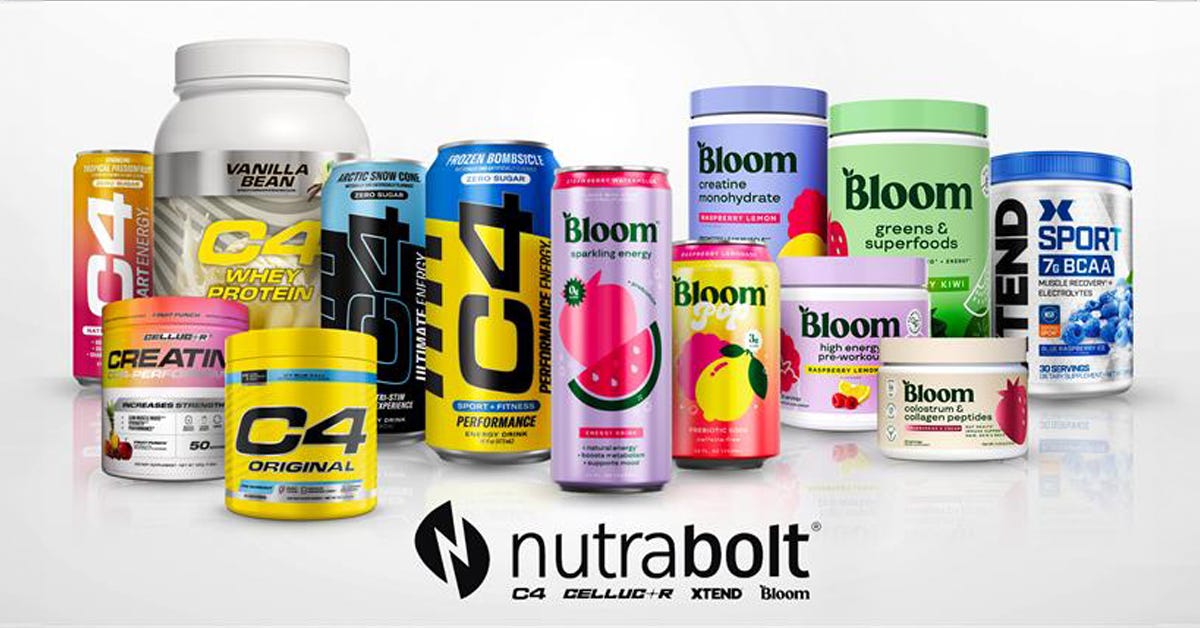
In January 2024, Bloom raised US$90 million, led by Nutrabolt along with Clayton Christopher and Amberstone. Nutrabolt put in US$50 million for about 20%. In September 2025 it added roughly US$160 million more, taking its total to about US$210 million. Add the two rounds and you get around US$250 million.
The more interesting part is who stands behind Nutrabolt. In December 2022, Keurig Dr Pepper invested US$863 million for about 30% of Nutrabolt, along with a long term distribution agreement. KDP is the group behind Dr Pepper and Snapple, and it delivers drinks through its own network. KDP is part of the Big 3 - Coke, Pepsi and Dr Peppers. It has incomparable distribution might.
Now the sequence. Bloom’s energy drink launched in July 2024, first at Target. KDP began distributing it in the fourth quarter of 2024, and the wider national push came in early 2025. Those are three different milestones: a launch, a contract starting, and a nationwide rollout.
Then the numbers. Bloom founder told Beverage Industry that its retail locations went from about 7,200 to about 14,700 over 2024. By July 2026, Inc. reported the energy drink in more than 60,000 stores, around half of them convenience stores, with drinks now making up roughly 75 to 80% of the company’s revenue. NielsenIQ data cited by BevNET showed over US$95 million in energy drink retail sales in under a year, through July 2025. That is what shoppers spent, not what Bloom booked as revenue. Forbes put the whole business at around US$500 million in annual revenue in April 2026. That is private company reporting and not audited.
I just can’t see it moving this fast without KDP’s network behind it.
4. What I take from Bloom
A few things stay with me.
First, the pitch to the retailer - Access to female shoppers who weren’t already coming in for energy drinks. That gives a buyer a reason to say yes. It wasn’t just another energy drink. The channel and the customer had to fit each other, and Bloom could explain why. For us, the question is what we would say to a buyer who has no reason to know us. [buyer refers to the category manager who decides which brand sells in their stores]
Second, selling in and selling through are different things. Stock going into stores makes a launch look big. Shoppers picking it up decides whether the store orders again. If I only watch the first, I’m fooling myself. I have done small experiments with clinics, and Shopee supermarket. Initial sell-through has not been encouraging.
Third, capital and capability are not the same. Money has a number on it, so it’s easy to compare. Access is harder to value. A partner can bring retailer relationships, category experience or a delivery network, and those change what you can do with the money. But look at the order again. Bloom had customers and proof of demand first. The partners came in to serve demand that already existed. They didn’t create it. So the thing to prove before you go looking for a strategic partner is demand.
Fourth, trust. I suspect trust mattered a lot between Greg and NutraBolt, and that being visible on social media in how he thinks and talks makes trust easier to build. This is why personal branding matters so much in today’s time. A genuine personal branding matters so much more than “made-up” personal brand that doesn’t really depict you. When you meet partners the reality will show up and relationships won’t build or grow.
And a caution. A distribution deal can’t make people buy a drink they don’t enjoy. Bloom was already big before Nutrabolt invested. Retailers need product to move. Distributors have other brands competing for their attention, and more stores means more stock to make, finance and support with promotions. I haven’t seen Bloom’s profit across the company. The greens powders have been reported as profitable, but beverage is another beast. A house can come down tumbling in a few weeks if costs aren’t managed well.
5. Singapore is not US
The first thing is size. The US has a huge customer base and national retail networks. A listing at one big retailer can spread across thousands of stores in one country. Singapore doesn’t work like that, so I’m careful about carrying US milestones over.
The second thing is that a Singapore brand doesn’t have to earn all its revenue from Singapore. Being based here and selling here are different. I’ll keep that in mind.
Let me look at two local examples. 100PLUS belongs to Fraser and Neave. F&N’s 2025 annual report calls it the number one isotonic brand in Singapore and Malaysia. The group made S$2.323 billion, the beverages segment made S$772.1 million, and beverage sales to Singapore customers came to S$125.4 million. That last number covers several brands, not only 100PLUS. Still, S$50 million would be about 40% of F&N’s entire Singapore beverage revenue. It tells me how big the 50M aspirational number is.
Ocean Health is closer to our world. Hyphens Pharma bought it in 2016. Its own revenue isn’t disclosed, but Hyphens’ whole Proprietary Brands segment, which includes Ocean Health, Ceradan and other products, reported S$36.7 million for FY2025. That’s a regional, multi-brand number, and it still sits below S$50 million. In February 2024, Ocean Health went into 112 selected 7-Eleven stores in Singapore, with easy formats like gummies and fast-melt powder.
I take two things from this.
S$50 million is a serious number, even next to names everyone here knows.
Ease matters. An easy format opened a door at a convenience chain.
I’m not saying it can’t be done. Bloom’s US numbers don’t set a ceiling for Singapore, and they don’t set a target either. We need to test our own demand.
6. What S$50 million looks like
I find it easier to think about a big number when I turn it into small ones. This is my arithmetic with estimated prices.
A fair price for a daily serving is what people already pay for a protein drink, around S$3.50 to 5 a bottle. I’ll use S$4. I’ll also assume retailers and distributors keep about 40%, so we net around S$2.40 a serving, after GST, returns and discounts. That 40% is a guess I still need to check.
Say we sell direct, and each active customer is worth S$500 a year to us. Then S$50 million needs about 100,000 active customers in a year.
Say we sell through stores in packs. A 10 day pack at S$40 on the shelf nets us about S$24, and a 15 day pack at S$60 would net about S$36. Sticking with the 10 day pack, S$50 million needs about 2.1 million packs a year, or roughly 5,700 a day. Singapore won’t have 1,000 stores that sell well. A realistic number is 200 to 300 stores, maybe 500, and only if the product has a very strong pull. Across 300 stores that’s about 19 packs a store a day. Across 500, about 11.
Say we sell single bottles at S$4 on the shelf and S$2.40 to us. Then it’s about 20.8 million bottles a year, or roughly 57,000 a day. Even across 500 stores that’s about 114 bottles a store a day. For perspective, 500 stores selling 20 bottles a day each would bring in about S$8.8 million a year.
Or a mix. S$20 million from direct, and S$30 million from stores in 10 day packs. That’s 1.25 million packs, or about 11 packs a store a day across 300 stores, and about 7 across 500.
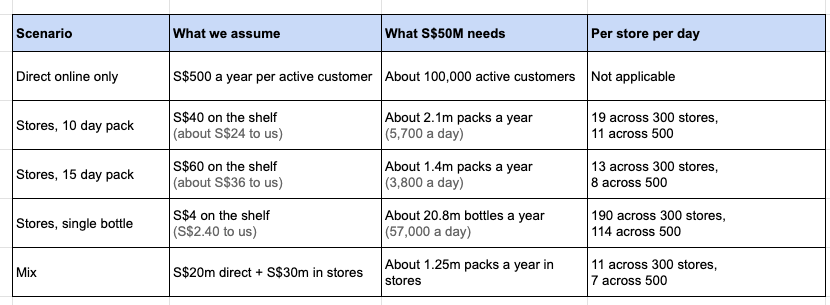
A few things come out of this. Stores alone are unlikely to carry S$50 million in Singapore. At 300 to 500 stores we’d need 11 to 19 packs a store a day, every day, which is very strong pull. So stores are one leg of the plan, next to direct, pharmacies and doctors, and markets outside Singapore. A Singapore brand doesn’t have to earn all its revenue here. The direct route needs 100,000 people who keep buying, which only works if the product is something people use often.
That last point matters most to me. Lower pricing is one way to bring more people in, but I don’t think it’s the only way. It only works if we still make money after every channel takes its share and customers come back.
Then there’s stock. I need to consider listing and promotion charges for retailers and payment terms. Being in every store only helps if the stock sells. Hyphens, the group behind Ocean Health, reported S$3.9 million in stock provisions and write-offs in FY2025, mostly for excess Sterimar inventory built the year before. That wasn’t Ocean Health, but it shows how this risk shows up even at group scale.
7. What I’m testing
I’m exploring a few things right now, and nothing is final.
On product, I’m looking at accessible and convenient formats, like fast melts and shots. A lot of what I read this week leans on format. Grüns built a daily habit around gummies in single-serve packets. Ocean Health used gummies and fast-melt powder to get into 7-Eleven. Wellbeing Nutrition built part of its range around Melts. A product that’s easy to take is easier to repeat, and easier to put on a shelf.
On channels, the challenge with our current products is that they won’t be distributed widely. Supplement claims are high risk, and that limits where products like ours can sit. So I’m looking at pharmacies and doctors for supplement distribution, settings where supplements already belong and where a person can explain them.
I’m also exploring RTD, ready to drink, with a simpler formulation for large retailers. That’s the Bloom route, and it comes with a huge cash outlay. Stock has to be made, moved and held before it earns anything. Preparing for that is part of the work I’m doing now.
These are explorations, not plans. I’m aiming to focus on one of them in 2027, and I’d rather pick it with some evidence than with excitement.
Back to where I started. The buyouts tell me that big companies pay for brands that have found demand and a way to reach people. Bloom shows what it looks like when both grow together, and then a partner arrives who can reach further than you can. For Xandro, I think the order is product first, then the door, then the partner. I’d like to get to a point where someone with a big network looks at what we’ve built and sees something already working.
If you run something of your own, I’m curious about your answer to this. What is the one thing between your product and your next 10,000 customers? Is it the product, the door, or the cash?
If you’d like to see what we make today, it’s all at Xandro Lab.
See you next Sunday
Shan
Sources: Bloom’s figures come from private company reporting, not audited accounts. Retail sales figures are what shoppers spent, not company revenue.
Modern Retail, January 2024: Nutrabolt talks began in early 2023
Taste Radio: The Playbook That Turned Nutrabolt Into A Billion-Dollar Disruptor
KDP, December 2022: Nutrabolt investment and distribution agreement
Inc., July 2026: 60,000 stores and the convenience store pitch
Unilever, April 2026: Grüns announcement, with June 2026 completion update
Entrepreneur India, December 2022: HUL stake in Wellbeing Nutrition