


👋 I’m Shan. I run Xandro Lab, a longevity science brand in Singapore. Every Sunday I write these notes, part building diary, part thinking out loud. This week is different. We just launched something we have been working toward for a while, and I want to share the founder’s version of what it is and where it is going.

In this post:
Lifespan, healthspan, peakspan — and what is still missing
What Biocap is
The measurement problem we are building toward
Why this is bigger than supplements
What I am personally building
Where this goes
1. Lifespan, Healthspan, Peakspan — and What Is Still Missing
The longevity conversation has evolved fast in the last decade.
The first frame most people encounter is lifespan — how long you live. David Sinclair, Bryan Johnson, the geroscientists running rapamycin trials and epigenetic clock research. The goal: extend the biological ceiling. The science is real and the people behind it are serious.
Then came the pushback. What is the point of 120 years if the last 30 are miserable? That gave us healthspan — not just how long, but how well. Disease-free years. The ability to sleep through the night, move without pain, stay sharp. Preventing the things that steal quality from the second half of life.
Then peakspan — a frame I have been using more recently. Not just living longer or avoiding disease, but extending the years where you are actually operating at your highest level. Sharp at work. Strong enough to compete. Present enough to build. For me personally, peakspan means being a high-performing CEO at 55 the way I am now. Competing at HYROX at the same level I do today. It is the frame that resonates most with people who are driven, early, and want to stay that way.
Three good frames. All useful. All describe where you are trying to go.
But none of them describe what you are actually building to get there.
You can want to live healthily to 90. You can want to stay sharp at 60. You can want to peak at 50 the way you peaked at 30. But what is the thing you are accumulating, day by day, decision by decision, protocol by protocol, that determines whether any of that actually happens?
That needed a new framing.
2. Enter Biocap
Biocap is biological capital.
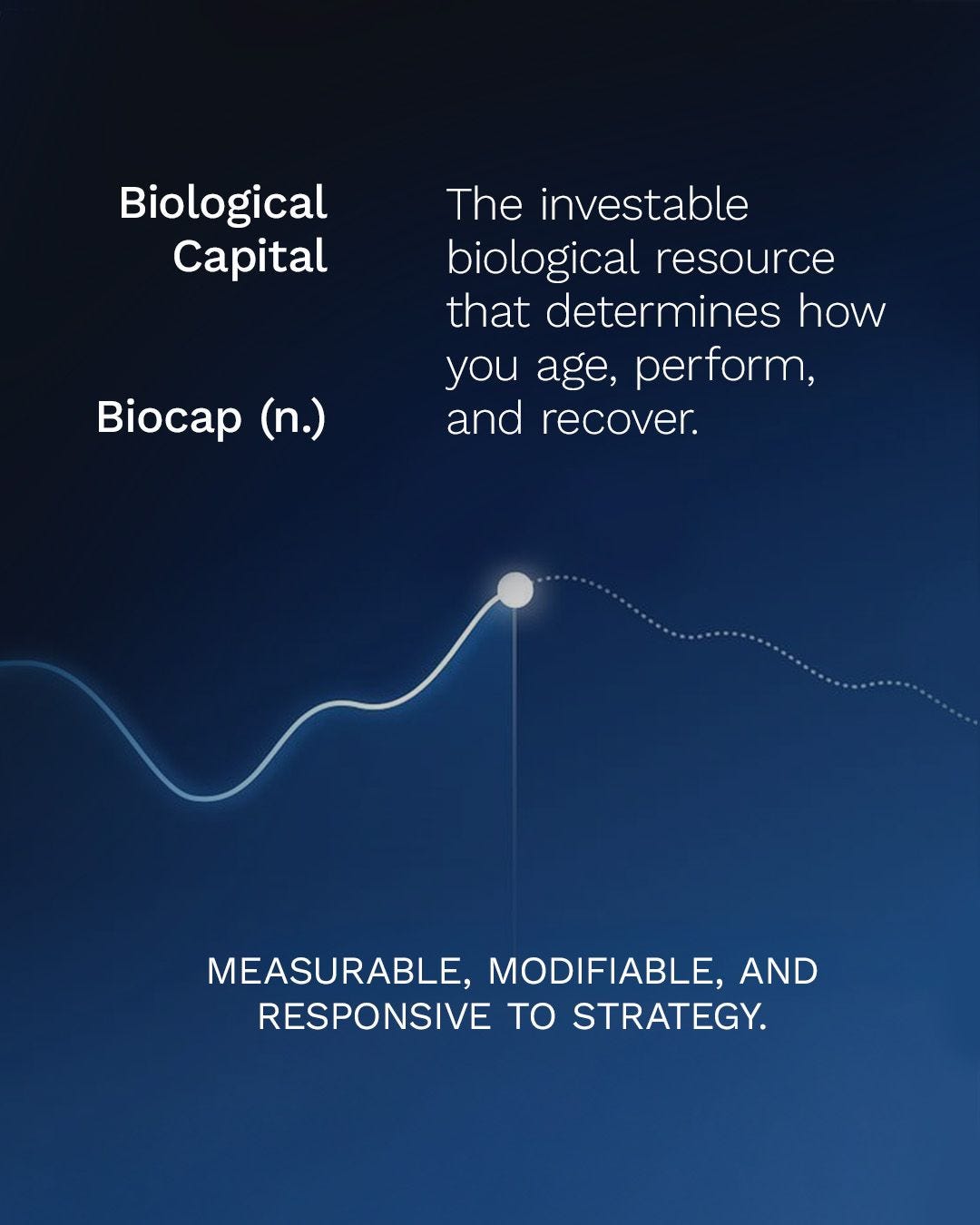
The logic clicked when we stopped thinking about health as a state and started thinking about it as an asset.
Financial capital accumulates. It compounds when managed well. It decays when ignored. It responds to strategy. It rewards consistency and punishes neglect. You can deploy it, protect it, or draw it down. The decisions you make early have a disproportionate effect on what you end up with later.
Your biology works the same way.
NAD+ levels, mitochondrial function, cognitive output, cellular repair capacity, structural resilience — none of these are fixed. They decline with age, and they decline faster without the right inputs. But they respond to strategy. They can be maintained, and in some cases improved, when the right protocols are applied consistently over years.
That is not health in the reactive sense — the kind you notice only when it disappears. Biocap is the proactive accumulation of biological resources that compound in your favor the earlier you start building them.
Think of it as a portfolio with five assets.
Cognitive Function. Focus, memory, processing speed under sustained pressure are not personality traits. They are biological outputs. Sharper at 50 than at 40 is not luck. It is the result of what you have been building since your 30s.
Performance and Recovery. How hard you can go matters. How quickly you come back matters more. Recovery built into a protocol from the beginning compounds differently than recovery treated as an afterthought.
Cellular Energy. NAD+ is the molecule at the center of this. By the time most people start thinking seriously about longevity, their NAD+ has already halved from its peak. The engine that drives every other system is already running at half capacity.
Longevity Pathways. Cellular repair, metabolic efficiency, the mechanisms that determine your biological age — not chronological age, but how old your cells actually are. This is the pillar that separates a Biocap protocol from a performance supplement stack. Its returns are measured in decades, not days.
Structural Resilience. Joints, connective tissue, oxidative defense. The infrastructure that holds the whole system together. Biocap cannot compound if the foundation underneath is quietly deteriorating.
These five assets are not independent. Cellular energy enables performance. Performance drives recovery demand. Recovery activates repair. Structural resilience protects the capacity to repeat the cycle. Build all five, deliberately, over time. That is what compounding looks like in biology.
3. The Measurement Problem We Are Building Toward
Here is the part I think about most, and the part that is honestly still being built.
Every serious longevity framework has found a number.
Healthspan age. Metabolic age. Epigenetic age — and every epigenetic testing company has their own version, their own clock, their own methodology. Biological age became a category because it gave people something to track. A number that moves. A score that reflects the work they are putting in.
BioCap needs the same.
Biological capital accumulates, but in what units? What does a strong BioCap look like at 35 versus 55? How do you measure the decay? When the inputs stop, how fast does it draw down? What does twenty years of consistent building look like, compared to someone who started at 50?
These are not rhetorical questions. They are the design problem I think about every week.
The answer will not be a simple score from one to a hundred. That flattens too much. It needs to capture accumulation across five assets, show decay when inputs stop, and reflect both short-term signals — energy, recovery, cognitive output — and long-term ones — cellular markers, structural health, biological age.
I want to be able to tell someone: this is your BioCap today, this is what is contributing to it, and this is what is drawing it down. That is the tool that makes this framework genuinely useful rather than just conceptually interesting.
We are building toward that. It will take time, clinical work, and rigorous data. But that is the direction. And I think about it the way an engineer thinks about a problem that is solvable but not yet solved.
4. Why This Is Bigger Than Supplements
Three years of building XANDRO has taught me something uncomfortable: supplements are not enough.
They are part of the answer. The right compounds, at the right doses, applied consistently, do things at a cellular level that matter. I believe that. I have built a company on it. But I have also spent enough time talking to researchers, professors, and clinicians to know that the gap between “this works in a study” and “this changes your life” is enormous — and it is filled with lifestyle variables that no pill can bypass.
The person who is chronically under-slept, sedentary, and living under structural stress is not going to get much out of a well-formulated NMN sachet. The supplement is rounding error compared to the structural problems.
This is why XANDRO has been moving into clinical work. Working with doctors. Engaging with regulated spaces, functional medicine practitioners, and the diagnostics layer. The problem of longevity is too large for supplements plus a nutritionist. It requires a broader solution set.
Exercise is probably the single most powerful Biocap intervention available. Sleep is foundational. Structural stress — a job that is draining you, a city that is wearing you down — can draw down Biocap faster than any protocol can build it. Diet matters in ways that are deeply personal and still poorly understood at the individual level.
Supplements occupy a specific role in this picture. They address gaps that food cannot fill, reinforce pathways that lifestyle alone cannot maintain, and in some cases target mechanisms that nothing else currently reaches. That is a real and important role. But it is not the whole role.
What I am building toward is a model where BioCap is the framework that connects all of it — diagnostics, clinical guidance, lifestyle architecture, and targeted supplementation — into something coherent and measurable. A doctor who understands functional medicine, physical health, and mental health together. Or more likely, given the complexity involved, an AI layer that can hold all of that simultaneously and surface what actually needs to change for a specific person at a specific stage of life.
That is the long game. XANDRO is the focal point of how we get there.
5. What I Am Personally Building
I track my own biomarkers. I test the products I sell. I race HYROX, run, and track recovery on Whoop. My Vitamin D is still not where I want it. My B12 is borderline. My leg development lags behind my upper body in ways my BIA scan makes uncomfortably visible.
I do not take everything that is out there. I am careful. Skeptical, even — which is an uncomfortable position when you run a supplement company and believe in the science. But holding that skepticism firmly and letting the evidence lead is the most honest thing I can do for the people who buy from us.
My father fractured his knee — his second leg fracture — from a simple fall on uneven ground. He never trained his muscles the way he should have. He is terrified of falling now. That fear makes movement harder, and harder movement makes everything worse. That trajectory is not just a family story. It is exactly what Biocap is trying to interrupt, decades earlier, in people who still have the chance to build.
My mother has knee issues and limited mobility. When I think about what I am building at XANDRO, I think about her too. Not just the customers. The people I was not present enough for. The generation that did not have this framework when they needed it.
Biocap, to me personally, is the ability to measure what I am building in my own body, know whether it is compounding or drawing down, and adjust. That is what I want for myself. And that is what I want to make available for everyone paying attention early enough to do something about it.
6. Where This Goes
BioCap is not a finished idea. It is an opening one.
The category will get sharper. The measurement framework will develop. The clinical evidence will build. The connections between the five pillars will become more precise as the science matures. What works for a 35-year-old athlete will be distinguished from what works for a 55-year-old executive, and both will be different from what is needed at 65.
I also expect the concept to be contested. The name carries an intentional tension — can you cap your biological capital? Is it finite? Should it be called something else? That debate is exactly what I want. Good frameworks survive discussion. Weak ones need protection from it.
What will not change is the direction. Deliberate. Research-backed. Long horizon. The opposite of chasing the next trend.
Your biology is either compounding in your favor or drawing down by default. Biocap is how you make that deliberate.
Build yours.
Shan, CEO and Co-Founder, Xandro Lab
Bridging the gap between longevity science and physical spaces is the next frontier. Excited to see how 'peakspan' translates into guest experiences.